
Loudoun County Court Records After Arrest
After a Loudoun County arrest, the jail record and the court record serve different jobs. The Loudoun County Adult Detention Center handles custody, intake, housing, and release facts. The courts handle the criminal case. Once a charge is filed or reviewed for prosecution, the case may appear in a Virginia court search with a case number, charge text, hearing date, court location, and status. For misdemeanors and many early felony events, that path often begins in Loudoun General District Court. Felony cases may later move to Circuit Court after certification, indictment, plea posture, or trial setting.
Virginia uses a Commonwealth's Attorney, not a district attorney. In Loudoun County, Commonwealth's Attorney R.D. "Bob" Anderson's office prosecutes felony, misdemeanor, traffic, and juvenile criminal cases and runs the Victim Witness Program. For custody and booking details, use Loudoun County jail inmate records. For booking-photo limits and request options, use Loudoun County jail mugshots. The court record after an arrest is narrower and more formal: it shows what the court is doing with the charges.
The Loudoun Circuit Court case-information page links the local clerk's criminal case path and gives the Criminal Division contact block.
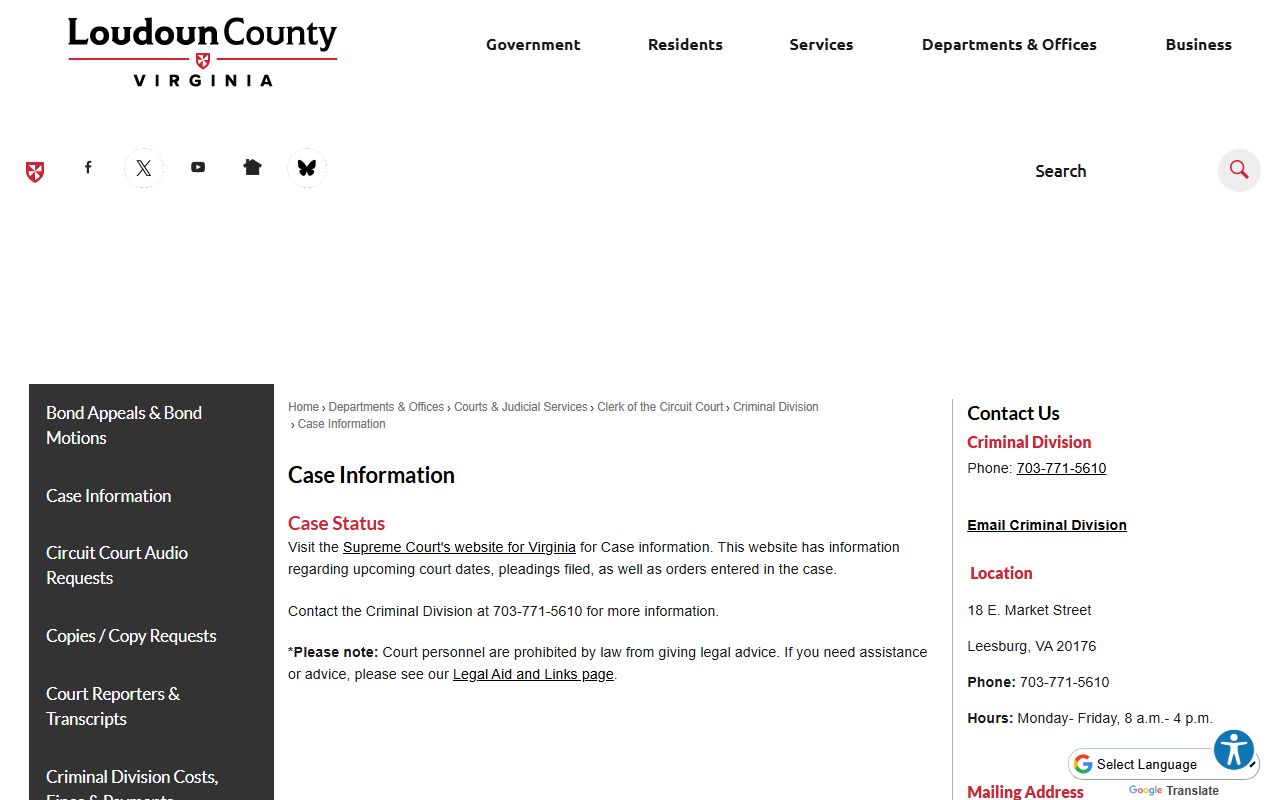
That court image fits the post-arrest path because felony cases and indictments may need the Circuit Court search or Criminal Division rather than the jail.
Find Loudoun County Court Records
Loudoun court records after a jail arrest can be searched through several official Virginia paths. The Virginia Online Case Information System, often called OCIS, is the broad statewide search for adult criminal case information in General District Courts and select Circuit Courts. The General District Court Online Case Information System is useful when the case is in Loudoun General District Court. The Virginia Case Status and Information page routes users to circuit, general district, and statewide tools.
- Select the Virginia court system that fits the case stage. Use General District Court for misdemeanors, traffic crimes, and preliminary felony hearings.
- Choose Loudoun as the locality when the search form asks for a court or county. This keeps common names from pulling cases in other Virginia courts.
- Search by defendant name, case number, or hearing date. Case number is best when it is known from a summons, warrant, bond paper, or clerk notice.
- Open each matching case and read the charge, court, next hearing, disposition, and status. One arrest can produce more than one case line.
- Check Circuit Court if a felony was certified, indicted, or moved out of General District Court after the first stage.
Loudoun General District Court is at 2 Church Street NE in Leesburg. Its public information phone is 703-777-0312, and clerk's office hours are 8 a.m.-4 p.m. The Circuit Court Criminal Division is at 18 E. Market Street, Leesburg, VA 20176, phone 703-771-5610, with Monday-Friday hours of 8 a.m.-4 p.m. The clerk page also states that public kiosks for criminal and civil digital records are available on the fourth floor of the Courts Complex across from the elevators and inside the Clerk's Office on the third floor.
The OCIS statewide search landing page is one of the main official starting points for Loudoun County court records after arrest.
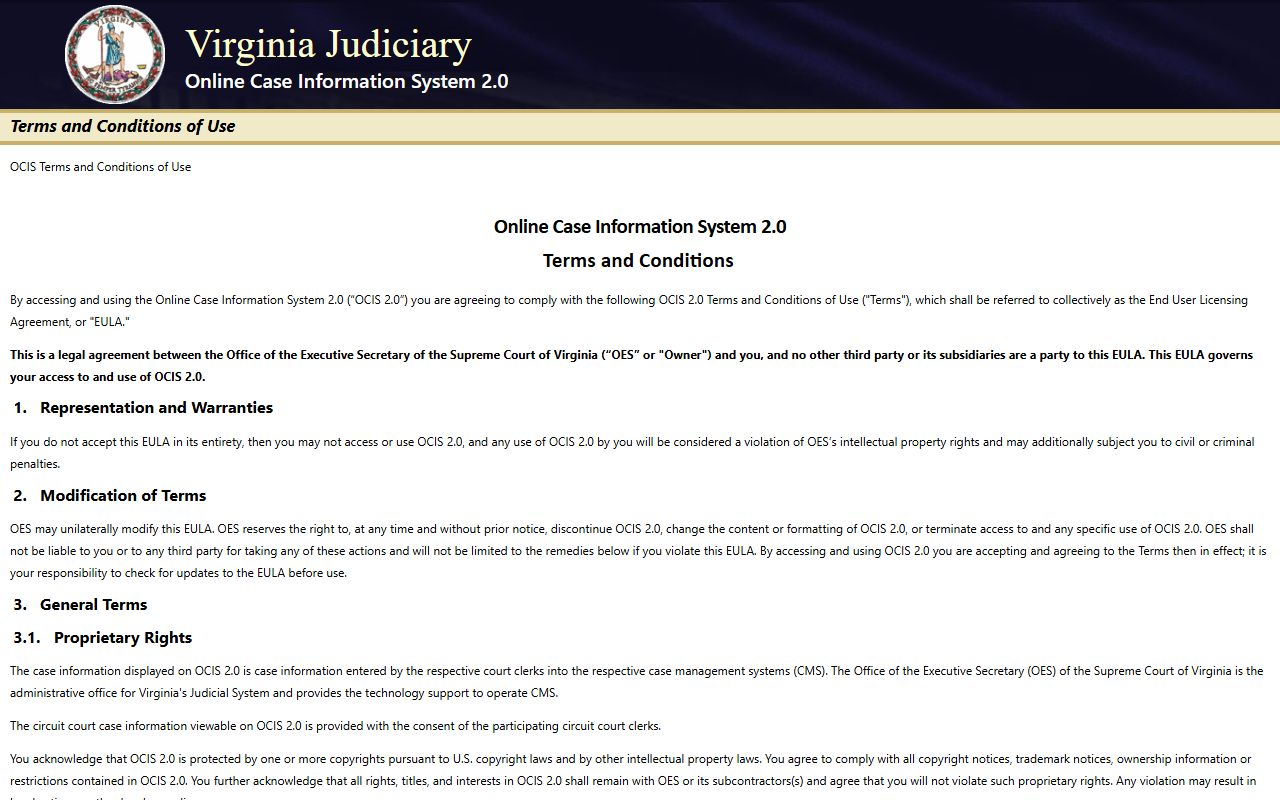
OCIS is useful when the exact court path is unclear, but a person still may need the GDC or Circuit search for full case detail.
Loudoun County Case Search Fields
The General District Court help materials document the main search fields for criminal and traffic cases. Use the spelling from the summons, warrant, bond paper, or charging document when possible. Name searches can return many results, especially for common surnames. A hearing-date search works when the date is known but the case number is not.
| Field Label | Type | Required | Notes |
|---|---|---|---|
| Court/locality | Dropdown | Yes | Select Loudoun General District Court or the Loudoun locality before searching. |
| Search by Name | Mode | Conditional | Returns matching cases for the name entered. |
| Last Name | Text | Yes for name search | Enter the last name as it appears on the court paper. |
| First Name | Text | Optional | Use to narrow the result set. |
| Middle Name/Initial | Text | Optional | Helpful when several defendants share a name. |
| Case Number | Text | Yes for case-number search | Use the exact court case number. |
| Hearing Date | Date | Yes for date search | Finds cases scheduled on a known date. |
Loudoun County Arrest Charging Documents
A court record after a Loudoun County jail arrest usually starts with a charging paper. The first allegation may come from a warrant, summons, complaint, or officer paperwork. The prosecutor may then amend, dismiss, or pursue the charge. Felony cases can move from an early General District Court hearing into Circuit Court by indictment or other procedural route. That is why the charge first heard after arrest may not be the final charge listed at disposition.
| Document | Who Uses It | Common Role After Arrest |
|---|---|---|
| Complaint or warrant | Officer, magistrate, or prosecutor path | Starts or supports the first criminal accusation and can lead to booking or a court date. |
| Information | Commonwealth's Attorney | Formal prosecutor filing used in some criminal cases when permitted by procedure. |
| Indictment | Grand jury and Circuit Court | Formal felony accusation that can move or continue the case in Circuit Court. |
Loudoun County Charge Status
A charge status is not the same as a final outcome. Court records after an arrest can show that a charge is pending, amended, reduced, dismissed, nolle prossed, certified, indicted, or disposed by plea or trial. "Nolle prosequi" means the prosecutor has declined to proceed on that charge at that time. A certified felony is one that has passed from General District Court toward grand-jury or Circuit Court handling. A disposition is the result or current end point shown by the court record.
| Status | Plain Meaning | Why It Matters |
|---|---|---|
| Pending | The case remains open. | Check the next hearing date and court. |
| Amended or reduced | The charge text, code, or level changed. | The arrest allegation may differ from the court charge. |
| Dismissed | The charge was ended by court action. | Dismissal may support later expungement review if the law allows it. |
| Nolle prosequi | The Commonwealth declined to prosecute that charge. | It is not the same as a conviction. |
| Certified or indicted | A felony moved toward Circuit Court. | Search both General District and Circuit records. |
| Convicted | A plea or verdict found guilt. | Sentencing, fines, jail, or probation may follow. |
Note: Court staff can provide public case access, but they cannot give legal advice about what a status means for a defendant.
Bond and Warrants After Arrest
Bond in Loudoun begins at arrest intake or a magistrate appearance. A magistrate may issue a warrant, set release conditions, or commit the person to jail. If the person is held, a judge can review bond later. LCSO media releases sometimes state that a person was held at the Adult Detention Center without bond, which shows that no-bond detention is used in local cases. The jail cannot override a court or magistrate order.
| Bond or Hold Type | How It Works | Where to Verify |
|---|---|---|
| Personal recognizance | Release on a promise and conditions without posting full security. | Magistrate or court record. |
| Cash or secured bond | Money or security must be posted before release. | ADC and the correct court clerk. |
| Surety bond | A licensed Virginia bondsman posts surety for a fee. | Court bond order and ADC release staff. |
| No bond | Release is not allowed unless a court changes the order. | Court record and counsel. |
| Detainer or hold | Another agency or case blocks release. | ADC, VADOC, BOP, ICE, or court systems. |
No official Loudoun active-warrant public search database was located in the research. A warrant can still appear through case events, capias entries, bond revocation, or failure-to-appear records. Loudoun Circuit Court Criminal Division can be reached at 703-771-5610, and General District Court public information is 703-777-0312. For urgent law-enforcement concerns, use LCSO main phone 703-777-0407 or 911.
Loudoun County Charges vs Convictions
An arrest and charge do not prove guilt. A booking charge is the allegation connected to custody. A court charge is the allegation being processed by the court. A conviction exists only after a guilty plea, a finding of guilt, or a verdict. This distinction matters when reading court records after a jail arrest because one event can show several stages at once.
| Point of Comparison | Charge | Conviction |
|---|---|---|
| Stage | Accusation after arrest or filing. | Resolved finding or plea. |
| Proof | Lower early-case thresholds may apply. | Requires plea or proof beyond a reasonable doubt. |
| Can change | May be amended, reduced, dismissed, certified, or indicted. | Can be appealed, modified, or affected by later court orders. |
| Record source | Court case search, charging paper, or clerk record. | Court disposition and sentencing record. |
Sealed and Expunged Arrest Records
Virginia FOIA supports access to public records, but it also includes exemptions and special rules for law-enforcement records. Virginia Code section 2.2-3706 governs law-enforcement and criminal records, including criminal investigative files. Title 19.2, Chapter 23.1 governs expungement of eligible police and court records. Juvenile records, sealed records, expunged records, medical facts, victim information, and active investigative material may be withheld from public access.
| Record Treatment | Plain Meaning | Loudoun Search Effect |
|---|---|---|
| Public | Available through court systems, clerk access, or lawful records request. | May appear in OCIS, GDC, Circuit, or clerk kiosks. |
| Sealed | Hidden from ordinary public view by court rule or order. | Search results may be limited or absent. |
| Expunged | Eligible police and court records are removed from public access through the statutory process. | Public case and law-enforcement access should be restricted as ordered. |
| Investigative file | Law-enforcement file reviewed under special FOIA rules. | Release can be denied or redacted under section 2.2-3706. |
Important: Public case searches are not consumer reports and should not be used for employment, housing, credit, insurance, or other FCRA-regulated screening.